



















The Nikon D7500 isn’t trying to chase trends—and that’s exactly why it still makes sense.
After extended use across wildlife, events, travel, and low-light shooting, the D7500 reveals its identity pretty quickly. This is a camera built for people who prioritize shooting experience and reliability over features on paper.
It inherits key tech from the D500, cuts a few things to stay accessible, and focuses heavily on performance. And in real-world use, that trade-off mostly works in its favor.
OVERVIEW IMAGE


Caption: A compact DSLR with pro DNA—deep grip, physical controls, and a design built around real shooting, not just specs.
DESIGN & BUILD
The D7500 feels like a tool, not a gadget.
The first thing you notice is the grip—deep, secure, and comfortable even with heavier lenses. Compared to entry-level DSLRs, it’s a clear step up in handling. You can shoot for hours without fatigue becoming a problem.
The monocoque body + weather sealing gives it durability without excessive weight. It’s not indestructible, but it’s built for real use—dust, light rain, outdoor conditions.
Control layout is classic Nikon:
- Dedicated dials for shutter and aperture
- Quick access buttons for ISO, WB, metering
- Minimal reliance on menus
The tilting touchscreen adds flexibility, especially for low-angle or overhead shots. It’s responsive, but not fully articulating—so vlog-style shooting isn’t ideal.
The Missing Dual Card Slot
This is the biggest controversy.
Previous D7000-series cameras had dual SD slots. The D7500 drops to one.
In practice:
- Casual users → won’t care
- Professionals → may miss redundancy
It’s a real limitation—but only if your workflow depends on it.
REAL-WORLD PERFORMANCE

Image Quality (The Core Strength)
The 20.9MP sensor—shared with the D500—is the reason to buy this camera.
Images are:
- Sharp without overprocessing
- Natural in color
- Strong in dynamic range
It doesn’t chase high megapixels. Instead, it delivers consistent, usable files across conditions.
Skin tones are particularly well-rendered, and highlights roll off smoothly—something that matters in real shooting more than resolution numbers.
Low-Light Performance
This is where the D7500 separates itself from typical mid-range DSLRs.
With native ISO up to 51,200, it performs extremely well in:
- Concerts
- Indoor events
- Night street photography
Noise is present at higher ISO—but it’s controlled and film-like rather than harsh.
More importantly, autofocus still works reliably in low light, which is where many cameras fail.
Autofocus & Speed
The 51-point AF system (15 cross-type) is fast and dependable.
In real-world use:
- Tracks moving subjects confidently
- Locks focus quickly
- Handles erratic motion well
Combined with 8 fps burst, it’s more than capable for:
- Wildlife
- Sports
- Action photography
It’s not D500-level tracking—but it’s close enough for most users.
Shooting Experience
This is where the D7500 really wins.
Everything feels responsive:
- Minimal shutter lag
- Fast buffer clearing
- Smooth operation
It’s the kind of camera that gets out of your way.
And that matters more than specs.
VIDEO PERFORMANCE

The D7500 supports 4K UHD, but video isn’t its main strength.
What works:
- Sharp 4K footage
- Decent color
- External mic support
What doesn’t:
- Contrast-detect AF in live view is slower
- No advanced video tools (log, advanced profiles)
It’s fine for hybrid shooters—but not a video-first camera.
FEATURES THAT MATTER

EXPEED 5 + D500 Sensor
This combo is what gives the camera its performance edge—fast processing, strong image quality, and reliable handling.
SnapBridge (Wi-Fi + Bluetooth)
Allows:
- Instant image transfer
- Remote shooting
It’s useful—but not always perfectly reliable.
Built-in Flash + Wireless Control
More useful than expected:
- Quick fill light
- Can trigger external flashes
Battery Life
~950 shots per charge is a major advantage over mirrorless cameras.
You can shoot all day without worrying.
TECH SPECS (ESSENTIALS)
| Category | Details |
|---|---|
| Sensor | 20.9MP APS-C (DX) |
| Processor | EXPEED 5 |
| ISO | 100 – 51,200 (expandable to 1.64M) |
| Autofocus | 51-point (15 cross-type) |
| Burst | 8 fps |
| Video | 4K UHD (30p) |
| Screen | 3.2″ tilting touchscreen |
| Storage | 1x SD card |
| Connectivity | Wi-Fi + Bluetooth |
| Battery | ~950 shots |
| Weight | ~640g |
PROS & CONS
| Pros | Cons |
|---|---|
| Excellent image quality (D500-level sensor) | No dual SD card slots |
| Strong low-light performance | Video features are limited |
| Fast, reliable autofocus | Live view AF is slower |
| Comfortable, ergonomic design | Not as compact as mirrorless |
| Long battery life | Connectivity can be inconsistent |
REAL USER FEEDBACK

User feedback around the Nikon D7500 reflects real-world use very closely.
Many long-time Nikon users upgrading from D5000/D7000 series describe it as:
- Faster
- More reliable
- Noticeably better in low light
There’s also frequent praise for handling—it’s a camera people enjoy using, not just owning.
The only recurring complaint remains the single card slot, especially among professionals.
WHO SHOULD BUY THIS?
You should buy the D7500 if:
- You prioritize photography performance over features
- You shoot sports, wildlife, or events
- You want DSLR ergonomics and battery life
- You’re upgrading within the Nikon ecosystem
Skip it if:
- You need dual card slots
- You focus heavily on video
- You want a lightweight mirrorless system
VERDICT
The Nikon D7500 isn’t trying to be modern—it’s trying to be reliable.
And that’s why it still works.
It delivers where it matters most:
- Image quality
- Autofocus
- Shooting experience
If your goal is to take photos—not just compare specs—it’s still one of the most satisfying cameras in its class.
The Review
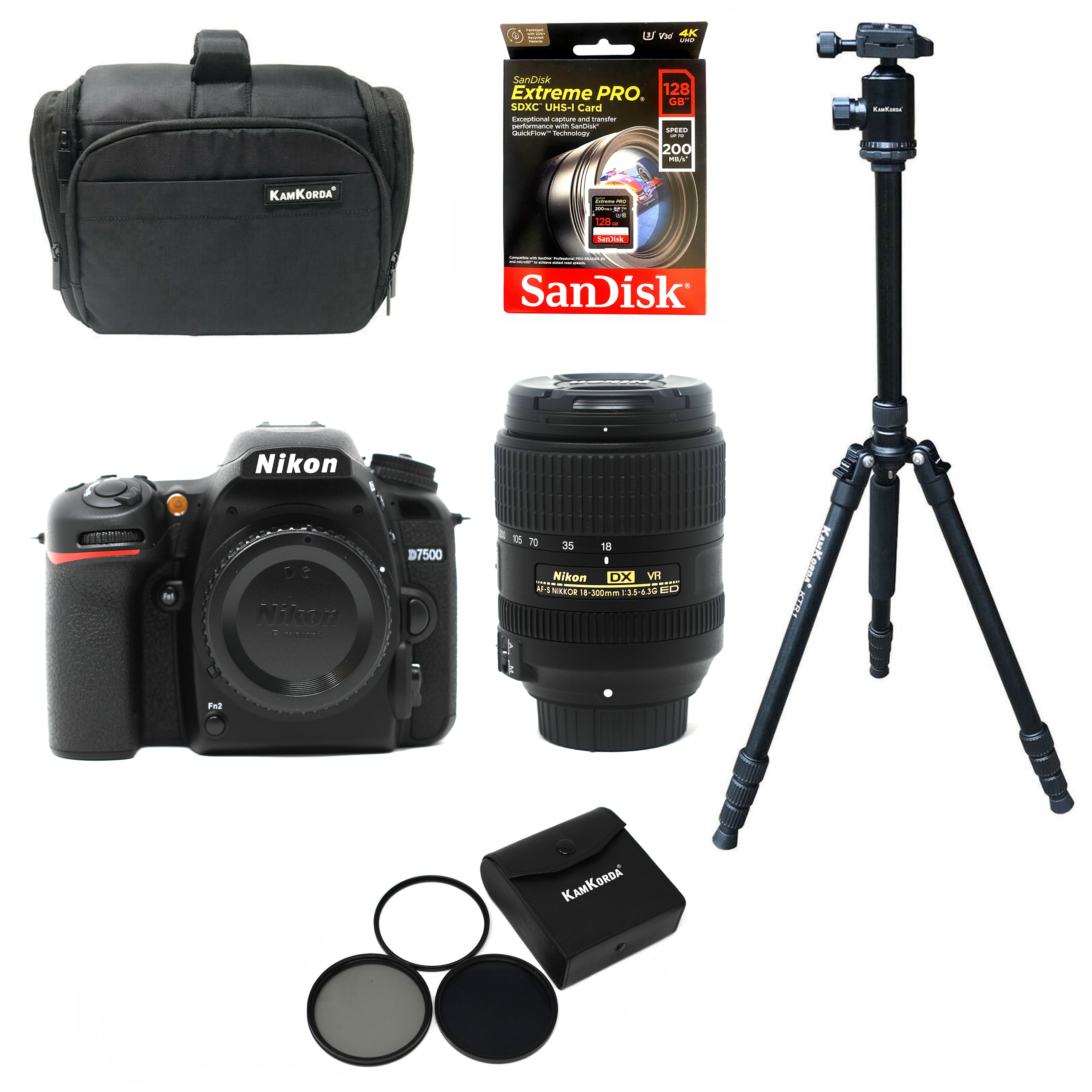
Nikon D7500 DX-format DSLR
This Nikon D7500 starter pack is great for any aspiring photographers who want to learn on a good DSLR camera. The camera is fairly easy to learn and there are good videos and guides out there to learn more. The info button on the camera itself actually allows you to learn what each function does as you go and is very helpful