




























There’s an old saying in military strategy: generals are always perfectly prepared to fight the last war. But what happens when the next war doesn’t look anything like the last one—not even remotely?
That’s exactly what is unfolding right now. Across modern battlefields, a quiet but profound transformation is taking place. Not led by tanks or fighter jets, but by algorithms, autonomous systems, and machines that don’t think like humans—because they don’t need to.
For decades, military dominance was defined by size, power, and technological superiority in hardware. Nations poured billions into stealth aircraft, aircraft carriers, and precision weapons designed for large-scale, conventional conflicts. But recent wars have exposed a harsh reality: these expensive systems are increasingly vulnerable in a world where speed, adaptability, and cost efficiency matter far more.
On today’s battlefield, a drone costing a few hundred dollars can identify, track, and destroy a multi-million-dollar tank in minutes—sometimes seconds. The balance of power is no longer about who has the best equipment, but who can act faster. The traditional “kill chain,” once measured in minutes or hours, has been compressed into near-instant decision cycles powered by AI.
And it doesn’t stop at remotely controlled machines. We are now entering the era of fully autonomous weapons—systems capable of identifying targets, making decisions, and executing actions without human intervention. These aren’t experimental concepts anymore; they are being deployed, tested, and refined in real-world conflict zones.
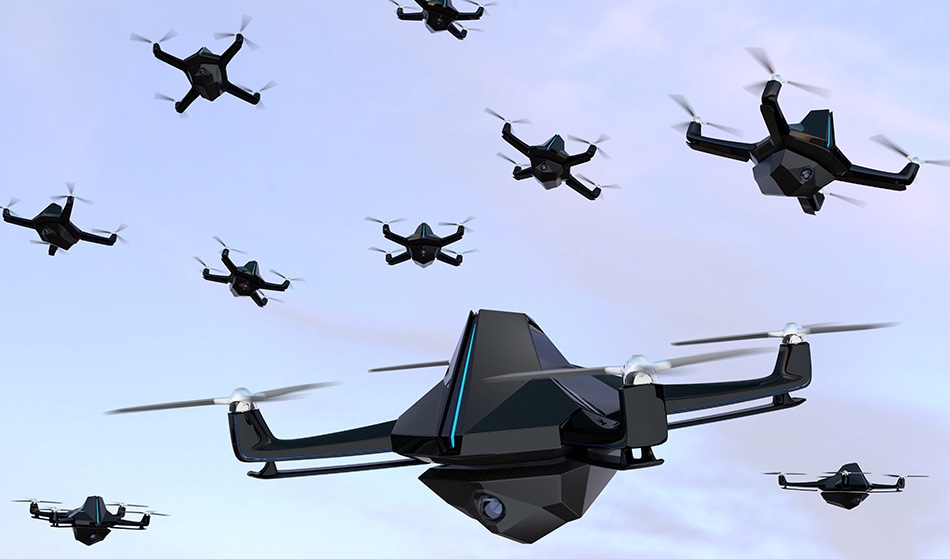
Perhaps the most unsettling development is the rise of drone swarms. Unlike traditional weapons, these systems don’t operate independently. They communicate, adapt, and reorganize in real time. If part of the swarm is destroyed, the rest immediately compensate—redistributing tasks and continuing the mission as if nothing happened. It’s warfare that behaves less like machinery and more like a living organism.
This shift also introduces a completely new economic reality. In the past, military advantage was tied to expensive, high-performance systems. Today, it’s increasingly defined by the ability to produce large quantities of cheap, intelligent machines. When a swarm of low-cost drones can overwhelm a sophisticated defense system, the equation changes entirely. Mass production begins to outperform precision engineering.

At the same time, some of the most dangerous threats are no longer visible at all. AI-driven cyber systems can scan, identify, and exploit vulnerabilities faster than any human operator ever could. Micro-scale surveillance technologies—tiny drones designed to resemble insects or birds—are pushing intelligence gathering into a realm that feels almost indistinguishable from science fiction. These systems can quietly observe, transmit data, and help construct real-time digital models of enemy environments.
Defending against this new kind of warfare is proving to be just as complex. Traditional systems simply weren’t built for it. Using a multi-million-dollar missile to destroy a cheap drone is not just inefficient—it’s unsustainable. As a result, new defensive strategies are emerging, focused on speed and scalability rather than brute force.
Directed energy weapons, such as high-powered lasers and microwave systems, are becoming one of the most promising solutions. Instead of firing physical projectiles, they can disable or destroy multiple drones almost instantly, dramatically reducing the cost per engagement. At the same time, electronic warfare systems attempt to disrupt communication and navigation signals—though even these are being challenged by newer autonomous technologies that no longer rely on external control.
Ultimately, the most powerful defense against AI may be AI itself. When attacks happen at machine speed, human reaction is simply too slow. The future battlefield may become a contest not between soldiers, but between competing algorithms—each trying to outthink and outmaneuver the other in fractions of a second.
What makes this transformation so significant isn’t just the technology—it’s what it represents. Warfare is no longer purely physical. It is becoming digital, autonomous, and increasingly detached from direct human control.
And that raises a final, unsettling question: if machines are making decisions on the battlefield, what role is left for us?