














The wireless microphone market just welcomed a major new entrant: GoPro. With the release of the GoPro Wireless Mic System, the company isn't just offering a dedicated audio upgrade for its action cameras—it's also targeting content creators shooting on smartphones and mirrorless setups.
Is this the ultimate compact audio solution for vloggers and creators in 2026? Let’s break down its design, performance, and features in this in-depth review.
1. Overview & Pricing Options
The GoPro Wireless Mic System marks GoPro’s official entry into a highly competitive segment currently dominated by DJI (Mic Series), Rode (Wireless GO / Micro), and Hollyland.
GoPro offers several bundle options to fit different needs and budgets:
- 2-Mic Combo Kit (2 Mics + 2 Receivers + Charging Case): $159 — The version tested in this review.
- USB-Only Kit (1 Mic + USB-C Receiver): $80
- Line Transmitter Kit: $50
2. Hardware & Design: Ultralight, Compact, and Versatile
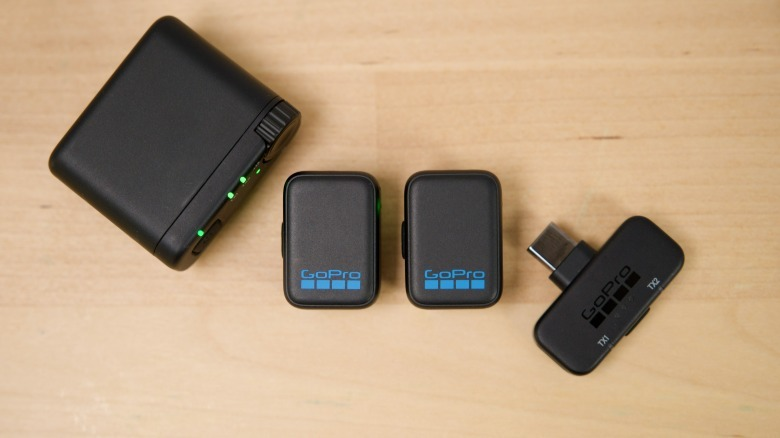
Transmitter (Microphone) Design
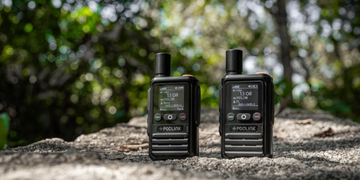
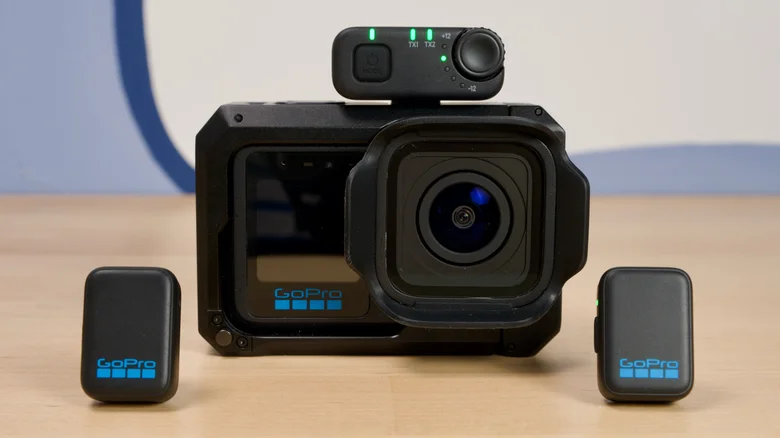
- Featherweight Build: Each mic weighs just 10g (0.3 oz). Being slightly smaller than the DJI Mic Mini, it clips onto shirt lapels effortlessly without sagging or pulling the fabric.
- Flexible Mounting: Features both a built-in clip and included magnetic mounts for easy concealment under clothing.
- Simple Controls: A single multi-function button manages power, pairing, and Noise Reduction activation.
Charging Case & Receivers
The $159 combo kit includes a compact charging case and two dedicated receivers:
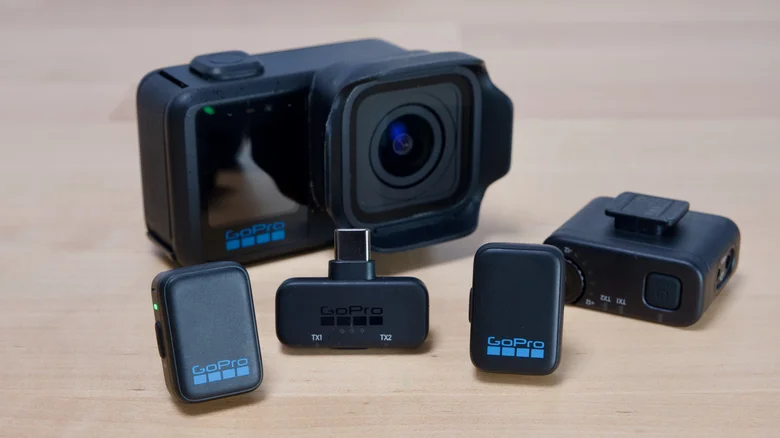
- 3.5mm TRS Receiver: Designed for DSLR/mirrorless cameras, featuring a manual gain control dial, a 3.5mm headphone jack for real-time monitoring, and mode toggle buttons (Stereo / Mono / Safety Track).
- USB-C Receiver: A ultra-compact dongle for phones, PCs, or the GoPro USB port, featuring a single button to cycle through three preset gain levels.
- Battery Life: Each transmitter runs for approximately 6 hours on a single charge. The charging case extends total battery life up to 20 hours.
3. Connectivity & User Experience
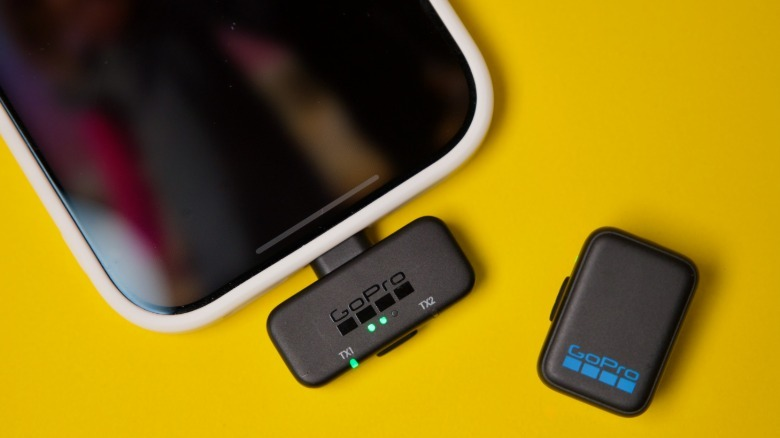
Direct Bluetooth Pairing (Receiver-Free)
Since the GoPro Hero 12 (and subsequent models like the Hero 13 / Mission 1 Pro), GoPro cameras have supported direct Bluetooth audio connections.
- The Advantage: You can pair one transmitter directly to the GoPro via Bluetooth, keeping your setup lightweight and maintaining basic water resistance without plugging in external accessories.
- The Catch: Direct Bluetooth connection only supports a single microphone. If you need to record two subjects simultaneously, you must use one of the physical receivers plugged into the camera.
Real-World Friction & UI Quirks
- Single VU Meter Bug: When using two mics via the USB-C receiver on a GoPro, the camera display only renders a single audio level meter (VU meter). While the camera successfully records both audio channels, it visually gives the impression that only one mic is connected.
- Split Channel Default: The USB dongle records both mics in “Split” mode (Mic 1 to the Left channel, Mic 2 to the Right channel). Without a physical Mono switch on the USB receiver, you'll need to merge the audio tracks to mono in post-production software (e.g., Premiere, CapCut) to avoid unbalanced playback on headphones.
4. Sound Quality & Performance
- Natural Audio Profile: Voices sound clean, natural, and well-centered with minimal room echo. Compared to the built-in microphone array or the GoPro Media Mod, the Wireless Mic System delivers a massive step up in clarity.
- Noise Reduction:
- Via Hardware Receiver: Noise cancellation performs exceptionally well, suppressing background ambient noise like fans and light traffic without distorting the voice.
- Via Direct Bluetooth: Enabling Noise Reduction over Bluetooth can introduce noticeable audio artifacts. In Bluetooth mode, it’s best to keep NR off and apply noise reduction in post-editing software instead.
5. Feature Comparison: GoPro Wireless Mic vs. Competitors
| Feature | GoPro Wireless Mic System | DJI Mic Mini / Mic 2 | Rode Wireless Micro |
| Price (2-Mic Combo) | $159 | ~$99 – $219 | ~$149 |
| Mic Weight | 10g (Ultralight) | 10g – 28g | 12g |
| Direct Bluetooth | Yes (Optimized for GoPro) | Yes | No |
| 32-Bit Float Recording | No | Yes (Mic 2) | No |
| On-Board Storage | No | Yes (Mic 2) | No |
| Built-in Display | No | Yes (on Receiver) | No |
| Total Battery Life | 20 Hours | 18 – 48 Hours | 21 Hours |
6. Final Verdict
Score: 7.8 / 10
Pros:
- Extremely compact and lightweight design (10g per mic).
- Versatile triple connectivity (Direct Bluetooth, USB-C, and 3.5mm TRS).
- Clear, natural sound quality with effective receiver-based noise cancellation.
- Seamless aesthetic integration with the GoPro ecosystem.
Cons:
- Direct Bluetooth connection supports only one microphone.
- USB-C receiver lacks an easy hardware toggle for Mono output.
- Minor UI glitch on GoPro displays (shows only one VU meter during dual-mic recording).
- No remote recording trigger button for GoPro cameras.
- Priced slightly higher than some entry-level competitors with similar feature sets.
Summary Recommendation
- Buy it if: You are a vlogger or creator already invested in the recent GoPro camera line, and you prioritize lightweight gear, fast setup times, and vastly improved voice clarity.
- Pass on it if: You require advanced audio safety nets like 32-bit Float recording, on-board backup recording, or dual-microphone capture over wireless Bluetooth without extra dongles.