
















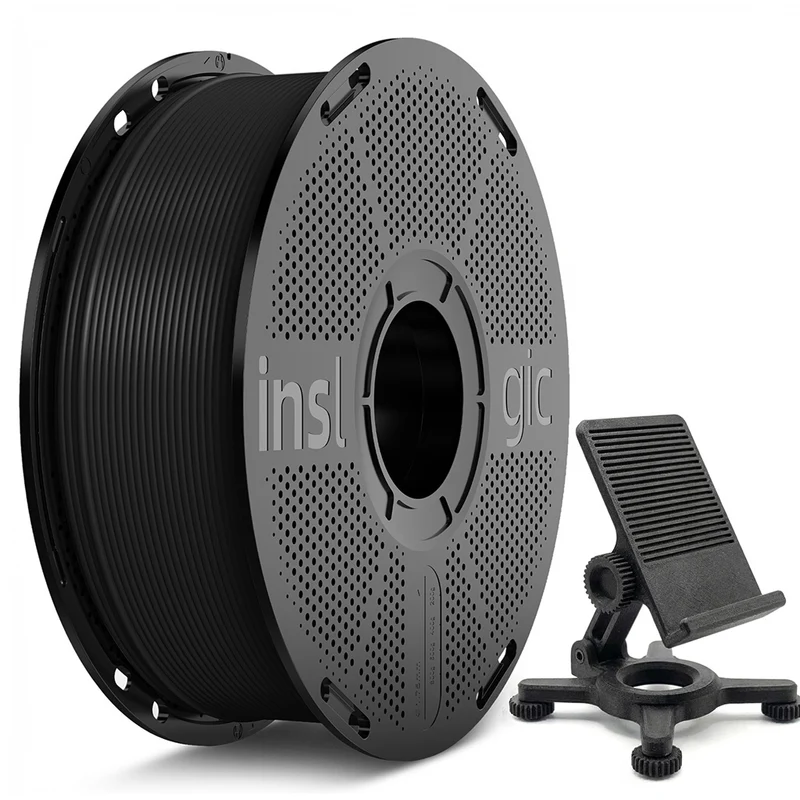
Looking for a PETG filament that combines reliable print quality, mechanical durability, and high-speed performance? The Inslogic PETG Pro Filament is designed for 3D printing enthusiasts, engineers, makers, and small businesses that need dependable materials for functional parts, prototypes, and everyday projects.
With a 1.75 mm filament diameter, a manufacturer-rated tensile strength of 50 MPa, and advertised printing speeds of up to 600 mm/s under suitable conditions, Inslogic PETG Pro aims to bridge the gap between everyday printing convenience and the performance requirements of more demanding applications.
But what makes this filament different from standard PETG? What are its technical specifications, and which types of 3D printing projects can benefit most from it?
In this guide, we examine its key features, technical properties, recommended printing settings, practical applications, and the factors to consider before purchasing.
Explore Inslogic PETG Pro Filament: Shop Inslogic
1. What Is Inslogic PETG Pro Filament?
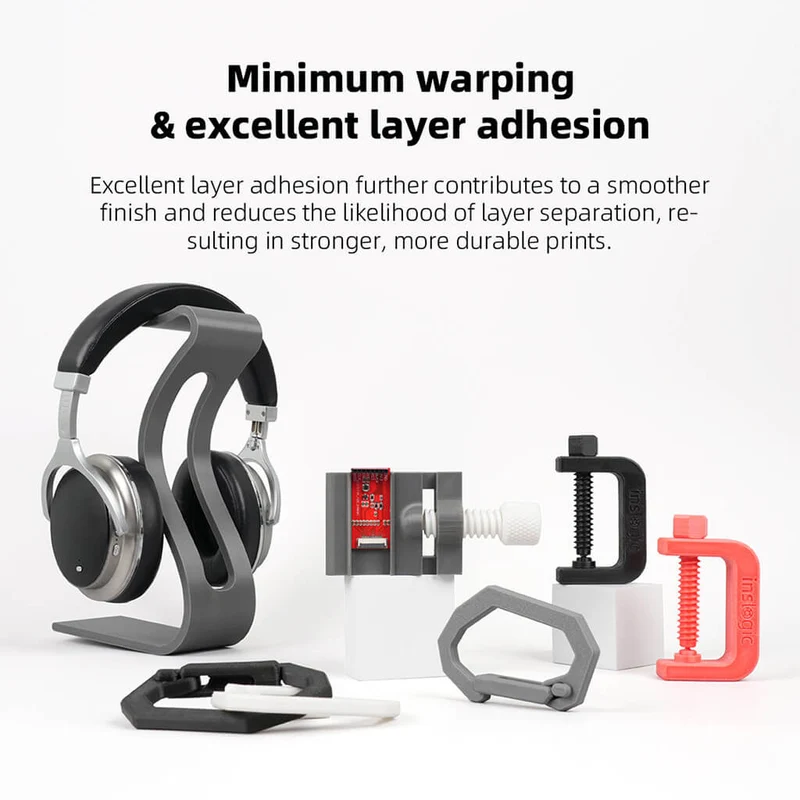
Inslogic PETG Pro is a glycol-modified polyethylene terephthalate filament designed for FDM (Fused Deposition Modeling) and FFF (Fused Filament Fabrication) 3D printers that use 1.75 mm filament.
PETG is a popular thermoplastic in 3D printing because it offers a useful combination of toughness, layer adhesion, and resistance to everyday wear. Compared with conventional PLA, PETG is often a better candidate for functional components that need to withstand repeated handling or moderate mechanical stress.
Inslogic positions its PETG Pro formulation as a material that combines the ease of printing associated with PLA with the durability and dimensional stability needed for functional applications.
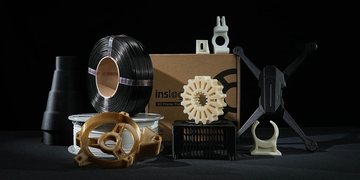
The product is designed for a broad range of projects, including:
- Functional mechanical components
- Mounting brackets and clips
- Electronics enclosures
- Prototypes and design models
- Workshop fixtures and jigs
- Storage organizers and practical household accessories
- Larger 3D printed parts that require dimensional consistency
Rather than focusing exclusively on decorative models, PETG Pro targets users who want their printed components to be both practical and durable.
2. Key Features of Inslogic PETG Pro
High-Speed Printing up to 600 mm/s
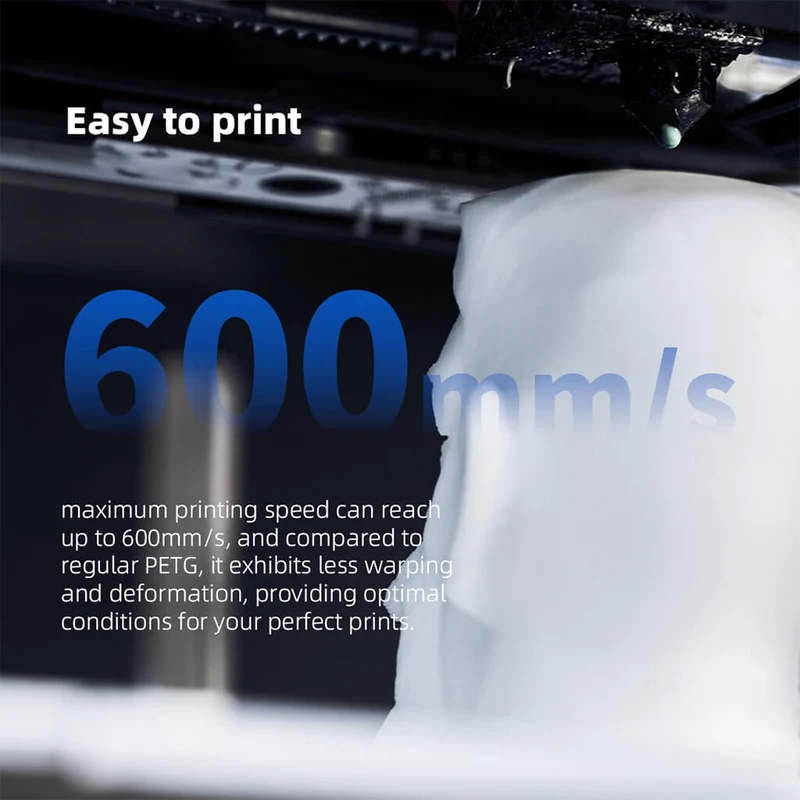
One of the most notable features of Inslogic PETG Pro is its advertised printing speed of up to 600 mm/s.
High-speed printing can help reduce production time, particularly when creating prototypes, replacement components, or multiple parts for a small manufacturing operation.
However, actual printing speed depends on several factors, including the printer's capabilities, hotend performance, extrusion flow, nozzle temperature, model geometry, and cooling configuration.
The maximum advertised speed should therefore be treated as a supported target under suitable conditions rather than a guaranteed speed for every printer and model.
For users with compatible high-speed printers, PETG Pro offers an option worth considering when productivity matters.
Low Shrinkage for Improved Dimensional Accuracy
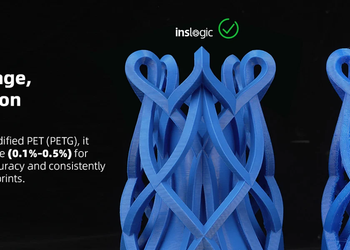
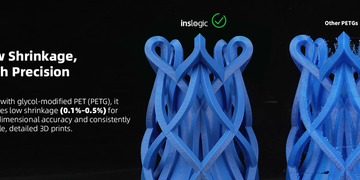
Inslogic reports a shrinkage range of approximately 0.1%–0.5% for PETG Pro.
Low shrinkage can help reduce dimensional changes during cooling, which is particularly useful when printing large objects or components that need to fit together accurately.
For example, mounting brackets, electronic enclosures, and mechanical fixtures may require precise dimensions to align with screws, slots, or other components.
Reducing shrinkage and warping can improve the consistency of these parts. Nevertheless, final accuracy also depends on calibration, print orientation, material conditions, and slicer settings.
Strong and Durable Printed Parts
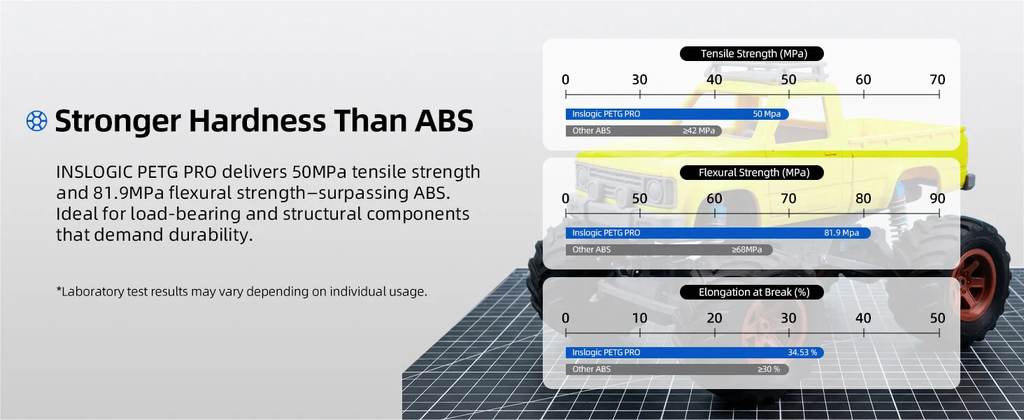
Inslogic PETG Pro has a manufacturer-reported tensile strength of 50 MPa.
This indicates its capacity to withstand tensile stress under the specified laboratory testing conditions. The material also has a reported elongation at break of 34.53%, suggesting that it can deform substantially before breaking under the relevant test conditions.
These properties make PETG Pro a candidate for functional components that need a balance of strength and toughness.
Potential applications include equipment holders, protective housings, brackets, organizers, and prototype components.
It is important to remember that a printed component's strength is not determined by filament properties alone. Layer adhesion, infill, wall thickness, print orientation, and operating conditions can all influence its actual mechanical performance.
Reduced Stringing and a Cleaner Printing Experience
Stringing occurs when small strands of molten plastic form between separate sections of a print as the print head moves.
Inslogic promotes PETG Pro as a formulation designed to reduce stringing and make PETG printing more manageable.
This can be valuable for detailed models, functional components, and parts that would otherwise require additional post-processing.
Actual results vary with filament moisture, nozzle temperature, retraction settings, travel speed, and the printer itself. Users should fine-tune these parameters to achieve the best results for their setup.
Chemical Resistance for Practical Applications
According to the manufacturer, PETG Pro offers resistance to several chemical categories, including acids, petroleum-based substances, esters, and alcohols.
This property may make the material useful for selected workshop components, housings, organizers, and other parts exposed to certain chemicals.
However, chemical resistance depends on the specific substance, its concentration, exposure duration, temperature, and the printed component's construction.
For critical industrial applications, users should verify compatibility with the exact chemical and operating environment before putting a printed part into service.
Multiple Colors and Refill Options
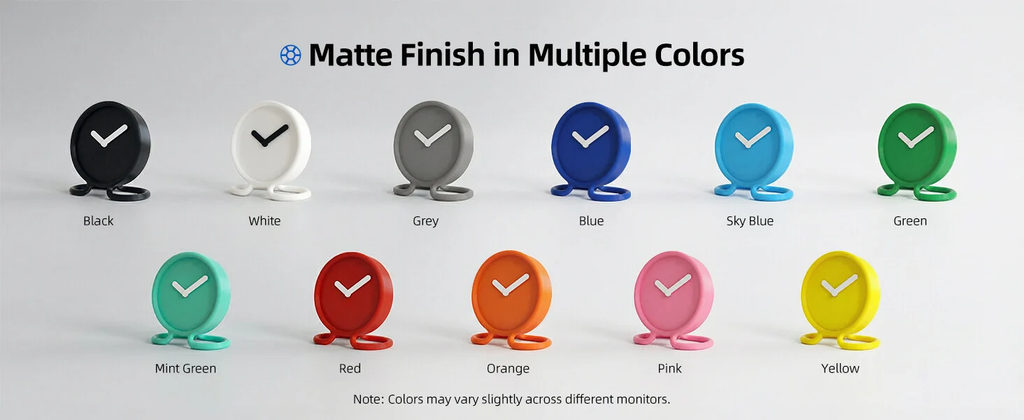
Inslogic PETG Pro is available in a range of colors, including black, white, gray, blue, red, yellow, orange, green, sky blue, mint green, and pink, subject to availability.
The product also offers two purchasing formats:
- With Spool: A complete filament spool for users who need a ready-to-use format.
- Refill: Filament supplied without the same complete spool assembly, intended for use with compatible reusable spool systems.
Refill compatibility should be checked before ordering. Inslogic provides guidance for its reusable spool system, and compatibility can depend on the spool design.
For makers who regularly consume filament, refill options may also be worth considering when comparing material costs and spool reuse.
3. Inslogic PETG Pro Technical Specifications
The following specifications are published by Inslogic for its PETG Pro filament.
| Specification | Manufacturer's Published Value |
|---|---|
| Material | Glycol-modified PET (PETG) |
| Filament diameter | 1.75 mm ± 0.02 mm |
| Net filament weight | 1 kg |
| Approximate filament length | 300 m |
| Tensile strength | 50 MPa |
| Elongation at break | 34.53% |
| Flexural strength | 81.9 MPa |
| Flexural modulus | 2,750 MPa |
| Glass transition temperature | 65.5°C |
| Heat deflection temperature | 72°C at 0.45 MPa |
| Reported shrinkage | 0.1%–0.5% |
| Advertised maximum printing speed | Up to 600 mm/s |
| Recommended nozzle temperature | Depends on printing speed; see the settings below |
| Recommended bed temperature | 60–70°C |
| Available formats | With spool and refill |
| Compatible printer category | FDM/FFF printers using 1.75 mm filament |
Important: These figures are manufacturer-reported specifications, not independent comparative test results. Actual mechanical performance and dimensional accuracy can vary with the printed part's geometry, orientation, layer settings, and operating environment.
4. Recommended Printing Settings
Choosing the right printing parameters is essential for achieving good surface quality, reliable layer bonding, and consistent results.
Inslogic provides different nozzle temperature ranges according to the intended printing speed.
| Printing Speed | Recommended Nozzle Temperature |
|---|---|
| 50–100 mm/s | 230–240°C |
| 100–300 mm/s | 240–255°C |
| 300–600 mm/s | 255–270°C |
Additional recommended settings include:
| Parameter | Manufacturer's Guidance |
|---|---|
| Heated bed temperature | 60–70°C |
| Cooling fan | 100% |
| Supported nozzle sizes | 0.2 mm, 0.4 mm, and 0.6 mm |
| Filament drying | 55°C for 4 hours |
| Suggested build surfaces | Smooth PEI sheet or high-temperature plate |
These settings are starting points rather than universal presets. Different printers, hotends, build plates, and slicer profiles may require adjustments.
Tips for Better Printing Results
Dry the filament when necessary. PETG can absorb moisture from the air. Moist filament may produce popping sounds, inconsistent extrusion, surface defects, or increased stringing. Inslogic recommends drying PETG Pro at 55°C for four hours.
Protect the filament during long prints. For prints lasting more than six hours, the manufacturer recommends moisture protection throughout the printing process.
Calibrate the first layer. A clean, properly leveled build plate and the correct nozzle-to-bed distance help establish reliable first-layer adhesion.
Adjust temperature gradually. If stringing or surface defects occur, test small temperature and retraction adjustments rather than changing several parameters simultaneously.
Evaluate the actual print. Test dimensional accuracy, surface quality, layer adhesion, and mechanical performance using a representative model before committing to a large production run.
5. What Can You Make with Inslogic PETG Pro?
PETG Pro's combination of toughness, dimensional stability, and practical chemical resistance makes it suitable for several categories of 3D printing projects.
Functional Parts and Mechanical Accessories
PETG Pro can be considered for brackets, clips, mounting components, holders, and other parts used in everyday equipment.
For these applications, the key considerations are dimensional fit, load requirements, layer orientation, and the environmental conditions in which the component will operate.
Electronics Enclosures
Custom electronics housings are a common use case for FDM printing.
PETG Pro may be suitable for selected enclosures, covers, cable-management components, and mounting structures where a balance of stiffness and toughness is desirable.
Electrical insulation, flammability, heat exposure, and regulatory requirements must still be evaluated separately when designing housings for electrical equipment.
Prototypes and Design Validation
Designers and engineers often use 3D printing to evaluate a product's shape, dimensions, assembly, and usability before manufacturing a final version.
PETG Pro's advertised low shrinkage and high-speed printing capability may be useful for producing prototypes and larger design iterations.
The material is particularly relevant when the prototype needs to demonstrate more than appearance alone.
Workshop Fixtures and Jigs
Small manufacturing operations frequently use custom fixtures to position parts, organize tools, or support repeatable assembly tasks.
PETG Pro may be suitable for selected fixtures and jigs, provided the design accounts for the expected loads, temperature, and wear.
DIY and Household Projects
Makers can also use PETG Pro for storage organizers, cable holders, equipment stands, replacement accessories, and other practical household items.
Its available color options offer flexibility for projects where appearance matters alongside function.
Application note: PETG Pro is a general-purpose 3D printing material, not a universal substitute for engineered industrial components. Applications involving safety-critical loads, food contact, medical use, high temperatures, or hazardous chemicals require additional material and design validation.
6. Printer Compatibility
Inslogic PETG Pro is designed for FDM/FFF printers that use 1.75 mm filament.
The manufacturer specifically identifies compatibility with Bambu Lab AMS and the A1 Mini.
However, compatibility should not be interpreted as a guarantee that every printer will achieve the same print quality or maximum advertised speed.
Before purchasing, check the following:
- Your printer uses 1.75 mm filament.
- Your hotend supports the recommended temperature range.
- Your printer can provide the extrusion flow required by your intended speed.
- Your build plate is suitable for PETG.
- Your filament feeding or automatic material system supports the selected spool or refill format.
If you are using a high-speed printer, start with the recommended temperature range and gradually optimize the settings for your machine.
7. Inslogic PETG Pro vs. Standard PETG
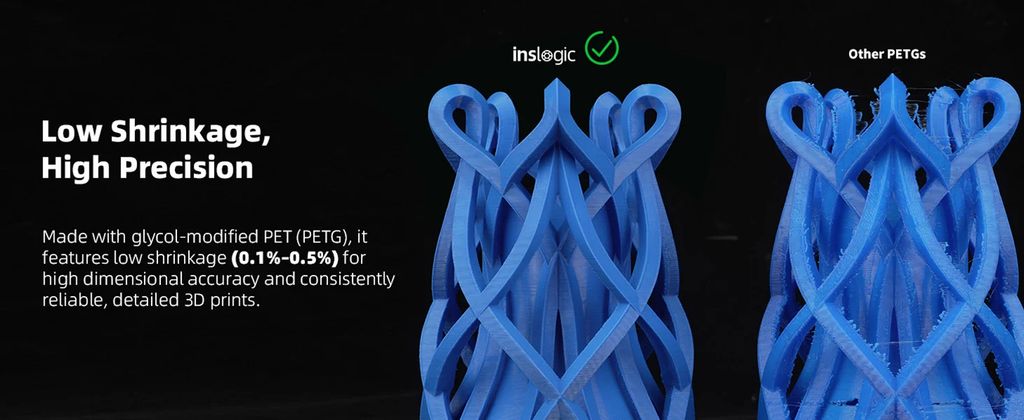
Standard PETG is already a versatile material for functional 3D printing. The question is whether a product such as PETG Pro offers benefits that justify its price.
| Comparison Factor | Standard PETG | Inslogic PETG Pro |
|---|---|---|
| Material category | PETG | Glycol-modified PETG |
| Ease of printing | Varies by formulation | Marketed for an easier, more consistent printing experience |
| Maximum advertised speed | Depends on the specific filament | Up to 600 mm/s |
| Shrinkage | Depends on the formulation | Manufacturer reports 0.1%–0.5% |
| Mechanical performance | Depends on the formulation | Published tensile strength of 50 MPa |
| Color selection | Depends on the brand | Multiple color options |
| Spool format | Depends on the brand | With-spool and refill options |
| Best evaluation method | Test the specific product | Test the specific product and printer combination |
This comparison describes the product positioning and available specifications; it does not establish that PETG Pro outperforms every standard PETG filament.
A meaningful comparison should use equivalent print geometries, layer settings, material conditioning, and testing procedures.
8. Is Inslogic PETG Pro Worth Considering?
Inslogic PETG Pro is worth considering for users who need a versatile filament for functional components, prototypes, and repeated production of practical parts.
Its main selling points are its published mechanical specifications, low-shrinkage claim, high-speed printing capability, range of colors, and availability of refill options.
It may be particularly relevant to:
- Makers who regularly print functional parts.
- Users with compatible high-speed 3D printers.
- Designers producing prototypes and larger models.
- Small businesses manufacturing custom printed products.
- Experienced hobbyists who want to explore alternatives to their current PETG filament.
On the other hand, buyers who primarily print decorative models or prioritize the lowest possible material cost may find that a standard, lower-priced filament meets their needs.
The most sensible approach is to compare the price per kilogram, printing consistency, supported printer settings, and real-world performance before making a decision.
9. Price, Purchasing Options, and Availability
Inslogic's product page has listed PETG Pro at approximately $22.99 for a 1 kg spool, although prices, promotions, and availability can change.
Buyers can choose between the complete spool and refill options, with several color selections depending on stock.
The website also advertises volume discounts at certain purchase quantities. Customers who regularly use filament may wish to compare these offers with their expected consumption and storage capacity.
Before ordering, verify the current price, shipping cost, delivery estimate, available colors, and refill compatibility for your location.
Where to Buy Inslogic PETG Pro Filament
To view the latest product details, check available colors, and review current purchasing options, visit the official Inslogic store.
Shop Inslogic PETG Pro and Explore Available Filaments
10. Final Verdict
Inslogic PETG Pro Filament targets a practical segment of the 3D printing market: users who want a material that can produce functional parts while supporting efficient printing workflows.
Its published specifications include a tensile strength of 50 MPa, a reported shrinkage range of 0.1%–0.5%, and an advertised maximum printing speed of up to 600 mm/s under suitable conditions.
The availability of multiple colors and refill formats also gives buyers additional flexibility when planning their projects.
However, the right filament depends on the printer, application, required mechanical properties, and budget. The manufacturer's specifications provide a useful starting point, but testing the material with your own printer and representative models remains the best way to evaluate its performance.
For makers, engineers, and small businesses looking for a PETG filament for functional 3D printing, Inslogic PETG Pro is a product worth investigating alongside other established PETG options.
Ready to explore the available options?
Visit Inslogic and Check PETG Pro Filament
The Review
Inslogic PETG Pro Filament 1.75mm
Inslogic PETG Pro Filament is designed for high-speed 3D printing, offering low shrinkage, dimensional accuracy, and durable prints. With a reported tensile strength of 50 MPa, advertised printing speeds of up to 600 mm/s under suitable conditions, and multiple color options, it is suitable for functional parts, prototypes, DIY projects, and everyday 3D printing applications.